 Literess
A writer’s glossary: beta readers, edits, story bibles and more
Plain definitions of the words writers meet between a first draft and a finished book: alpha and beta readers, the kinds of editing, story and series bibles, continuity errors, manuscript format, and what AI-assisted and AI-generated mean.
 Mariia Ivakhnenko
 Vitalii Vlasiuk10 min read
Between a first draft and a finished book, writers meet a vocabulary of their own: alpha readers and beta readers, four kinds of editing, story bibles, continuity errors, comp titles. Each term below is defined in its first sentence, so you can read the one you need and move on.
Who reads your draft before it is published?
What is an alpha reader?
An alpha reader is the first person to read a draft, often while it is still rough or unfinished. They read for the big picture: whether the premise works and the story holds their interest, not for polish.
What is a beta reader?
A beta reader is someone who reads a finished draft as an ordinary reader would and tells you how it lands: where they got lost, what they didn’t believe and where they put it down. Most beta readers are volunteers; paid beta reading runs at 0.5 to 0.8 cents a word, the Editorial Freelancers Association’s 2026 median range. An AI beta reader does the same job in conversation, on any page, as often as you revise.
What is a critique partner?
A critique partner is a fellow writer who swaps drafts with you, usually chapter by chapter, so each reads and comments on the other’s work. Unlike a beta reader, they read as a writer and suggest how to fix what doesn’t work.
What is a sensitivity reader?
A sensitivity reader is a reader, usually paid, who checks how a book portrays a community or an experience they know first-hand, and points out what may be inaccurate or hurtful.

What kinds of editing are there?
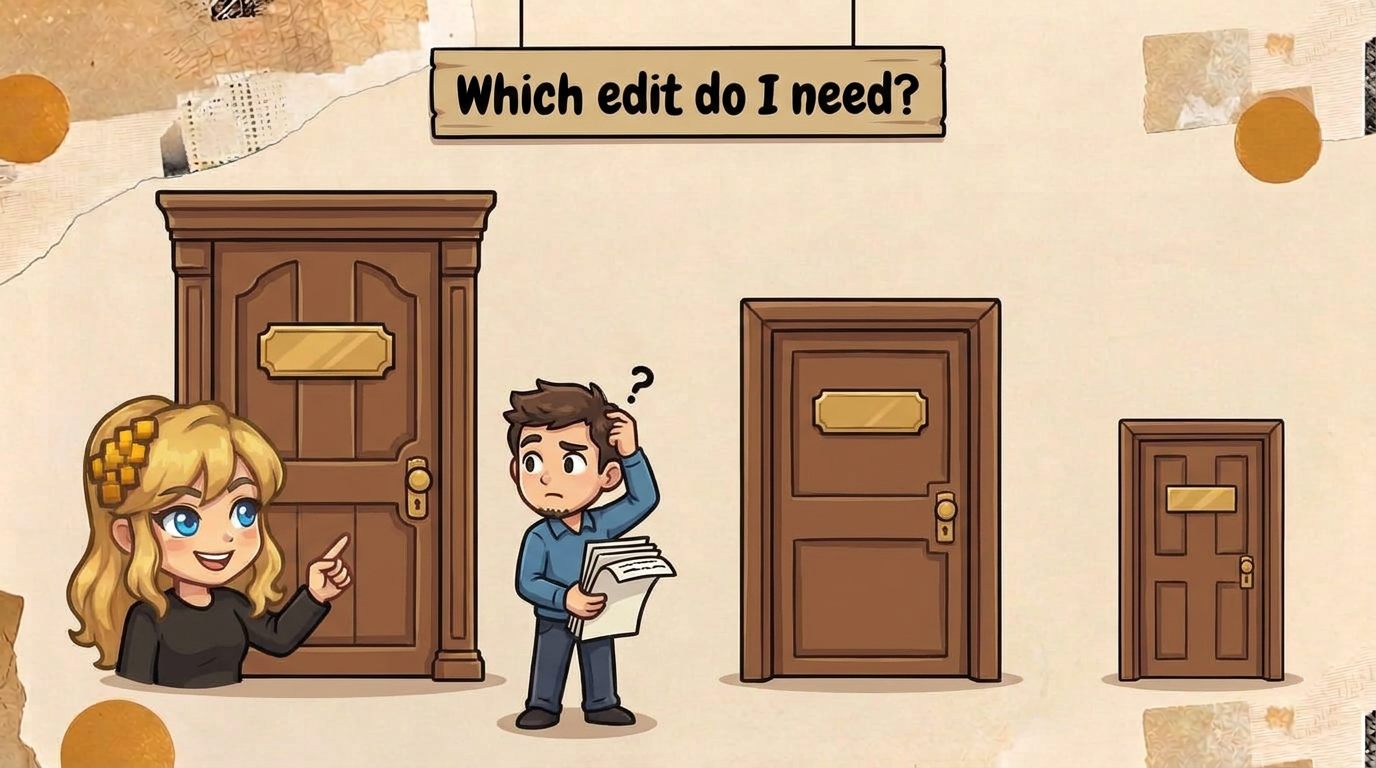
Editing comes in stages, from the whole book down to the comma, and each costs more the earlier and deeper it goes.
| Service | What it covers | When | Fiction rate per word (EFA 2026 median) |
|---|---|---|---|
| Manuscript assessment | A report on the whole book’s strengths and problems | A revised draft | 1.5 to 1.8¢ |
| Developmental edit | The assessment plus notes through the manuscript | A revised draft | 3.0 to 3.5¢ |
| Line edit | Style, sentence by sentence | Once the story is settled | 2.7 to 3.5¢ |
| Copyedit | Grammar, consistency, facts | Before typesetting | 2.0 to 2.7¢ |
| Proofread | The last typos, on the laid-out pages | Last | 1.2 to 2.0¢ |
What each costs for a whole novel is in our guide to feedback and editing costs.
What is a developmental edit?
A developmental edit (or structural edit) is a professional editor’s work on the big things: plot, structure, pacing, character and point of view, with a report and notes through the manuscript on how to fix what doesn’t work. It comes first, because there is no point polishing sentences in a chapter that may be cut.
What is a manuscript assessment?
A manuscript assessment (also called an editorial assessment or critique) is a professional reading of the whole book and a written report on what works and what doesn’t. It covers the same ground as a developmental edit without marking up the pages, so it costs less.
What is a line edit?
A line edit works on the prose sentence by sentence: rhythm, word choice, clarity, repetition and voice. It assumes the story itself is settled.
What is a copyedit?
A copyedit checks correctness and consistency: grammar, spelling, punctuation, house style, and facts such as names, dates and a character’s eye colour. Copyeditors keep a style sheet for the book as they work.
What is proofreading?
Proofreading is the last check, on the laid-out pages, for typos, missing words and layout errors that crept in. It isn’t a substitute for a copyedit.
How do you keep a long book straight?
What is a story bible?
A story bible is the reference document a writer keeps beside a book or a series: characters and what they look like, places, how the world works, what happened when. Our article on how to keep one has a template, and the story map builds one from the scenes themselves.
What is a series bible?
A series bible is a story bible for several books, which also records what changed between them: who aged, who died, what was revealed. It matters most from the third book on, when the facts you need are spread over years of writing. See Literess for series writers.
What is a style sheet?
A style sheet is the copyeditor’s list of decisions for one book: spellings, capitalisation, invented words, names, and facts such as ages and dates. The Chicago Manual of Style recommends keeping one, and the CIEP publishes a guide to style sheets for fiction.
What is a continuity error?
A continuity error is a detail that contradicts something established earlier in the book: an eye colour that changes, a character in two places at once, a weekday that can’t be. Most come from revision, when a cut or moved scene leaves a line behind. How to catch them, and what happened when we planted ten.
What is a plot hole?
A plot hole is a gap or contradiction in the story’s logic: an event that couldn’t happen given what came before, or a question the book raises and forgets. A continuity error is a small plot hole; a missing motive for the climax is a large one.
What is a retcon?
A retcon (retroactive continuity) is a later revelation that changes what earlier events meant, on purpose. Done well it is a twist; done by accident it is a continuity error.

What do writers call things on the page?
What is point of view (POV)?
Point of view is whose eyes the reader sees the story through, and how close: first person (“I”), third person limited (one character’s perspective at a time), or omniscient. Writer’s Digest describes how close the narration sits to a character as emotional distance.
What is head-hopping?
Head-hopping is switching point of view between characters within a scene without a clear break, so the reader can’t tell whose thoughts they are in.
What are filter words?
Filter words are verbs such as saw, heard, felt, noticed and realised that put the character’s perception between the reader and the scene (“She saw the door open” instead of “The door opened”). Our filter word finder counts them in your text.
What is a dialogue tag?
A dialogue tag is the phrase that says who is speaking, such as “she said” or “he asked”. Most editors prefer plain “said”, which readers barely notice. Check yours with the dialogue tag checker.
What is an action beat?
An action beat is a small action placed next to a line of dialogue to show who is speaking and what they are doing, instead of a tag (“She put the cup down. ‘I’m leaving.’”).
What is an info dump?
An info dump is a long passage of background or explanation that stops the story to tell the reader things, usually early in a book.
What does “show, don’t tell” mean?
“Show, don’t tell” is the advice to let readers see a feeling or a fact through action, dialogue and detail rather than being told it outright: a character’s hands shaking rather than “she was nervous”. Telling still has its place, for summary and pace.
What is foreshadowing?
Foreshadowing is a hint early in a story at something that will matter later. The principle that a detail introduced prominently should pay off is often credited to Anton Chekhov, as “Chekhov’s gun”.
What is an unreliable narrator?
An unreliable narrator is a narrator whose account the reader can’t fully trust, because they lie, misunderstand or don’t know. It is one reason a continuity check must keep what a character believes apart from what is true.
What do you need to submit a novel?
What is a word count, and how long should a novel be?
A word count is the length of a manuscript in words, the measure agents and publishers use. Writer’s Digest puts most adult novels at 80,000 to 89,999 words, science fiction and fantasy at 100,000 to 115,000, and young adult at 55,000 to 79,999. Count yours with the word counter.
What is standard manuscript format?
Standard manuscript format is the plain layout agents and editors expect for a submission: a readable 12-point font, double spacing, one-inch margins, numbered pages and a header with your name and the title. William Shunn’s guide is the usual reference, and our manuscript format tool produces a Word file in that layout.
What is a query letter?
A query letter is a one-page letter to a literary agent that pitches your book: a hook, a short summary of the story, its length and genre, and a line about you.
What is a synopsis?
A synopsis is a summary of the whole plot, ending included, usually one to two pages, that agents ask for alongside a query to see that the story works.
What are comp titles?
Comp titles (comparable titles) are two or three recently published books similar to yours, named in a query to show where it would sit on a shelf and who would buy it.
What do the AI terms mean?
What is AI-assisted writing?
AI-assisted writing is text you wrote yourself and then used an AI tool to edit, refine or check. Amazon KDP doesn’t require you to disclose AI-assisted content.
What is AI-generated writing?
AI-generated writing is text an AI tool created, even if you edited it heavily afterwards. Amazon KDP asks you to declare it when you publish, and the Authors Guild asks authors to disclose substantial AI-generated text to readers and publishers. Where the lines fall
What is an AI beta reader?
An AI beta reader is an AI tool that reads your draft as a first reader would and tells you how it lands, without writing it for you. Our guide to AI beta readers compares them.
Sources
All checked 25 November 2026.
- Editorial Freelancers Association, Editorial Rates (2026 chart).
- Amazon KDP, Content Guidelines; The Authors Guild, AI Best Practices for Authors.
- CIEP, Creating style sheets for fiction; CMOS Shop Talk, Section 2.52 in the spotlight.
- Jane Friedman, The story bible.
- Writer’s Digest, Word count for novels and children’s books and Managing point of view and emotional distance.
- William Shunn, Proper Manuscript Format (novels).
- Writer’s Relief, Avoid these filter words.
Co-founder, Literess
Co-founder of Literess and of its sister product, Transept. Three degrees in English Language and Literature (Kyiv, Ostrava, and a year in Salzburg), and a Ukrainian native who lives most of her writing life in English. Came into AI as a prompt engineer, then product and lifecycle marketing. She writes semi-fictional stories about real people.
Co-founder, Literess
Builds Literess, and co-founded its sister product, Transept. Writes as “Mevkh.” A Language and Literature degree, then a turn into software: a senior AI engineer shipping production LLM features to 50,000+ users. A novelist on the slow path, with 120,000 words of satirical romance fantasy in a drawer, which is the manuscript Literess was first built to read.